Trends
/
Feb 19, 2026

João Filipe Carneiro
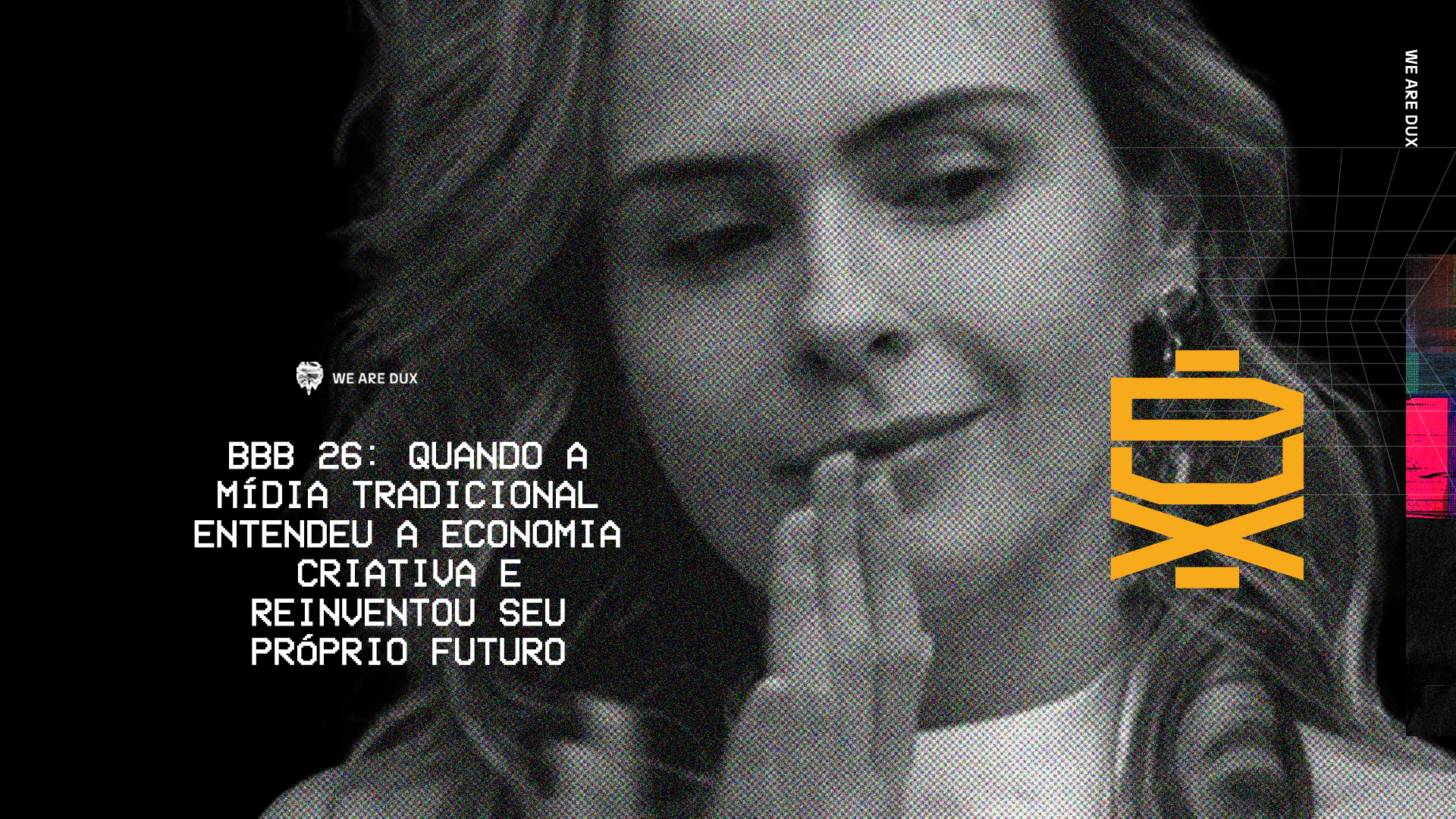
Big Brother Brasil 26 (BBB 26), Brazil's flagship reality show, didn't just premiere on an LED screen in the living rooms of millions of Brazilians; it premiered as an omnipresent entity that fragmented the very notion of "prime time". If in 2002 the show was a monologue by Globo, the broadcaster nicknamed "the Platinum Venus", in 2026 it is an ecosystem of billions of interactions where linear television is only the first spark of a digital wildfire.
The number is crushing: just 24 hours after the premiere, the cast had already piled up more than 58 million followers. For comparison, that is more than the entire population of many European countries combined. We are no longer talking about "contestants on a show"; we are talking about one-person media companies that decided to merge their assets with a communications giant.
The provocation here is direct: if the country's biggest broadcaster figured out that its survival depends on validating and absorbing the power of the people who create content, why does the financial system still treat the creative professional as an "adventurer" with no collateral? BBB 26 is the death certificate of the business model that ignores the Creator Economy. It proves that attention is the new global currency, and whoever doesn't know how to liquidate that currency is doomed to be forgotten.
Television didn't reinvent itself out of kindness or innovative spirit; it reinvented itself out of brutal necessity. The Gen Z audience doesn't watch "segment 1" and wait for the commercial. They consume the clip on TikTok, argue about the conspiracy theory on X (formerly Twitter), and buy the outfit from the leader's challenge through an affiliate link on Instagram, all in under five minutes. BBB 2026 is the confirmation that the economy no longer revolves around the product, but around the narrative. And where there is narrative, there is value. Where there is value, there must be liquidity.
Big Brother Brasil as the Last Stronghold (and the First Victim) of Linear Television
To understand how far BBB 26 has come, we need to look in the rearview mirror, back to 2002, when the world was analog and the viewer's patience was infinite. Back then, the reality show was the peak of vertical broadcasting: the network owned the camera, the cut, the narrative and, above all, the clock. The audience was a passive receiver whose only "superpower" was dialing a phone number — and paying for it — to eliminate someone the edit had already painted as the villain.
In that structure, value lived in scarcity. There was one screen, one time slot, and one conversation. If you missed the 10 p.m. broadcast, you were out of the conversation at the coffee machine the next morning. It was the era of control media. Sponsors bought seconds of forced silence (the commercials), and contestants left the show to, at best, land on the covers of magazines that today don't even exist in print. There was no digital trail, no lasting community; there was only the fleeting phenomenon of TV ratings.
The problem is that the world moved from "watching" to "taking part". The linear, hierarchical, predictable model started to bleed when the internet stopped being dial-up and became the air we breathe. Television, once the sun every planet orbited, suddenly found itself turned into just one more satellite in a solar system governed by recommendation algorithms.
In 2026, "linear television" is a romantic concept. What BBB 26 does today is no longer "airing a show", it is feeding a beast that is starving for fragments. The centralized narrative is dead. Today the show is a patchwork quilt stitched together by millions of amateur editors on TikTok, Reels, and Shorts. Globo understood that to keep the show alive, it had to give up total control. It had to accept that the conversation about its product is worth more than the product itself.
That transition from control to organized chaos is a perfect mirror of the creative economy. In the old model, you asked permission to be heard. In the DUX model, in the logic of creators, you build your own platform and traditional media is the one asking to be part of it. BBB 26 is not the end of TV; it is TV admitting that it is now a support platform for whoever really holds the attention: the creator.
Digital Gold: Monetizing Attention in the BBB 26 Ecosystem
In the 2026 landscape, BBB has stopped being a test of physical endurance and become a test of digital asset strategy. When a content creator walks into the house today, they are not only chasing the million-real prize at the end of the show — which, let's be honest, is often smaller than what their channels bill in a month. They are there to run an "influence IPO".
The arrival of the "Camarotes" — the celebrity contestants — and the professionalization of the "Pipocas" — the unknowns, who now walk in with management deals and a ready-made visual identity — reveal the great opportunity of our decade: turning attention into capital. On BBB 26, the contestant is a multiplatform brand. While they sleep inside the house, their team "on the outside" runs a sales machine: affiliate links, launches of their own products, licensing deals, and advertising contracts triggered by how they perform in the game.
This is the essence of the creative economy DUX stands for. Opportunities once restricted to large conglomerates are now in the hands of individuals with a loyal community. The target audience — photographers, videomakers, influencers, and strategists — has realized the reality show is the "super-amplifier". If you have the right content and an engaged audience, you have a signed contract in the future.
The opportunity here is scalability. In the old model, you worked by the hour. In the BBB 26 and Creator Economy model, you work by impact. A 15-second "clip" placed well in the algorithm can generate six figures in advertising contracts over the following months. The big insight for the creative professional in 2026 is understanding that they are not just providing a service; they are building intangible equity with real market value, auditable and, now, ready to be anticipated.
The market has finally understood that the engagement of a loyal audience is predictable cash flow. If your advertising contract schedules payment for 90 days from now, that is not just a promise; in the modern economy, that is a financial asset. BBB 26 only throws the door wide open: content creation is the most strategic profession of the 21st century, and the monetization opportunities are endless for anyone who stops thinking like an "artist" and starts thinking like an owner of intellectual property.
The Abyss Between Viral and Real: The Invisible Risks of the Attention Economy
If on one side BBB 26 is a machine for manufacturing relevance, on the other it exposes the structural fragility of the creative professional. The great risk of 2026 is not getting cancelled — that is already part of the game and can even be monetized — but financial asphyxiation from a broken cash flow.
Many creators and agencies orbiting the reality show's ecosystem face a cruel irony: they hold signed advertising contracts with astronomical numbers, but they are operating in the red. That happens because traditional media and the big brands still run on "dinosaur" payment terms (30, 60, 90, or even 120 days), while the speed of creation demands immediate investment. To keep an editing, paid traffic, social media, and audiovisual production structure worthy of a BBB contestant, the cost is high and it is due now.
The biggest obstacle here is the illusion of liquidity. Having 10 million followers and a R$ 200,000 contract payable three months from now does not buy the new gear to replace what broke today, and it does not pay the team that has to stay up all night editing the clips from the "Paredão", the weekly elimination vote. That temporal "gap" is where a lot of promising talent dies. They are rich on paper and insolvent in real life.
There is also the risk of algorithmic dependence. On BBB 26, the creator is at the mercy of a platform that isn't theirs. If the algorithm changes, or if engagement drops before the payment hits the account, that professional's bargaining power collapses. The volatility of attention is a high-risk asset. Without solid financial management to turn that volatile attention into immediate security, the creator gets stuck on a hamster wheel: producing desperately to cover the costs of a fame that has not yet turned into money available in the bank.
The real obstacle, then, is not a lack of work or talent, but the lack of financial infrastructure compatible with the speed of the internet. The traditional banking system looks at a contract from a BBB influencer and sees "uncertainty". They ask for physical collateral — cars, apartments, land — for something that is purely digital and intellectual. That mismatch is the final barrier keeping the creative economy from reaching its full potential for professionalization.
Clash of the Giants: Why the Traditional Bank Doesn't Understand BBB 26
The mismatch between traditional media (which has already reinvented itself) and the traditional financial system (still in a plaster cast) has never been as obvious as it is in the BBB 26 scenario. On one side, broadcasters and brands already operating at real-time speed; on the other, banks that still require the content creator to "fit" into occupation categories that look like they came out of the 90s.
When an influencer or an audiovisual production company knocks on a commercial bank's door trying to finance an operation built on advertising contracts, the culture clash is immediate. The average manager is still looking for "payslips" or "real collateral". To them, a contract signed with a multinational for a campaign that will run in the reality show's commercial break is nothing more than a "promise on paper". They can't price digital relevance, and they can't grasp that in the creative economy the asset is intellectual property and the capacity to deliver.
Traditional credit solutions are, by definition, bureaucratic and slow. They demand months of relationship, piles of physical documents and, often, rates that don't reflect the security of a contract already signed by a major company. For the BBB 26 professional, waiting 15 days for a credit analysis is the equivalent of an eternity. In the time the bank takes to approve a limit, the contestant's hype has passed, the trend has changed, and the business opportunity has evaporated.
This is where the watershed appears. While banks treat the creator as a risk, the new economy treats them as a value generator. The comparison is simple: on one side, bureaucracy that jams the flow; on the other, technology that reads the data. Modern solutions don't ask for your house as collateral; they validate that your contract is real and that whoever is going to pay you is financially healthy. The focus shifted from "how much physical property do you own" to "how solid is your receivable".
BBB 26 proved that attention is liquid. If the media market has already accepted this, the part of the financial market that doesn't adapt will end up like the video rental store: watching from the outside as the ones brave enough to change the rules of the game move forward.
The Financial Shortcut for the Generation That Can't Wait
If BBB 26 is the showcase where attention is traded, DUX is the infrastructure that keeps that trade from stalling for lack of liquidity. To use our central metaphor, picture the content creator in a high-speed race. The signed contract is the fuel, but it is locked in a tank that only opens 60 days from now. With no fuel now, the car pulls over onto the shoulder while the competition flies past. DUX is the refueling in mid-flight.
We are not a bank; we are a shortcut. We understand that the creative professional — whether the influencer with millions of followers on the reality show, the photographer who shot the magazine cover, or the production company that edited the video packages — runs on a different clock than the bureaucratic one. On our platform, the analysis is not based on endless forms or "brick-and-mortar collateral". We use AI and data intelligence to validate your contract in real time.
The process is designed for people in a hurry who won't give up security:
No Paperwork: You register with your CNPJ (your company's tax ID) and basic data. It's direct, intuitive, and digital.
Elite Analysis: While the traditional market scratches its head, our team and our technology validate the payer on your contract (that big brand or agency) in less than 1 hour.
Instant Liquidity: Once approved, the money lands in your account in up to 24 hours. It's the end of "paper wealth".
For the BBB 26 ecosystem, this is revolutionary. It means an agency that closed five advertising contracts for its talent doesn't have to go into debt at the predatory interest of an overdraft to pay the editing team today. It anticipates what is already rightfully its own, with competitive fees (between 2.5% and 4.5% per month), and keeps the creative flow running without interruptions.
DUX steps in as the strategic partner that removes financial friction. We speak the creator's language: we focus on agility, on transparency, and on respect for the time creation takes. If BBB turned TV into a content ecosystem, DUX turned the contract into cash in hand, so the creative's only concern can be, well... creating.
The Future Belongs to Whoever Owns Their Own Time (and Flow)
BBB 26 is not an outlier; it is the new standard. What we saw this season — creators running complex media ecosystems inside and outside the house — is proof that the wall between "entertainment" and "business" has been permanently demolished. In the future, every creative professional will be, to some degree, a manager of attention assets. The question that remains is not whether you will generate value, but whether you will have the tools to control the timing of that value.
The creative economy is maturing. We are leaving the phase of "viral amateurism" and entering the phase of financial sovereignty. The ones who thrive after the BBB 26 phenomenon will be the ones who understand that talent is the engine, but cash flow is the oil that keeps the engine from seizing. Preparing for the future means no longer accepting the constraints of the past. It means understanding that if your work is digital and fast, your money cannot be analog and slow.
The Revolution Will Not Be Televised, It Will Be Anticipated
The big lesson traditional media learned from Big Brother is that you have to give ground to win. TV handed the spotlight to creators and, in doing so, secured its own relevance. The financial market is going through the same process. DUX is at the front of that transition, making sure the creative economy professional is treated with the respect and the speed their scale deserves.
In a world where a video crosses the ocean in milliseconds, it no longer makes sense for payment on a finished job to take months to arrive. Liquidity is the freedom to say "yes" to the next project, to hire the best editor, to invest in technology, and to scale your personal brand without the weight of financial anxiety.
The Shortcut to Your Next Big Idea
The story of BBB 26 teaches us that the ones who dictate the rules today are the ones who hold the community and the contract. But the story of DUX teaches that whoever has the money in hand today is the one who really governs tomorrow.
You don't have to wait for the "Paredão" of financial life to find out whether your business survives the next month. If you have signed contracts, you already have the capital. It is just locked inside a bureaucracy that isn't yours. It's time to use the shortcut, keep your creation flowing, and focus on what you do best: building the future of culture.
Want to turn your future contracts into breathing room right now? DUX is the simple, fast, no-bureaucracy solution for you to get your receivables in up to 24 hours.
[Anticipate your receivables with DUX and never stop creating]
Some other materials of ours that may interest you